
Why zero-downtime migration is non-negotiable
In 2025, my team at Rocket India executed one of the most complex infrastructure migrations we'd undertaken: moving our entire Confluent Kafka cluster to Private Service Connect (PSC). The cluster carried the mortgage servicing platform, which runs continuously. Downtime was not an option.
This article documents the strategy, execution, and lessons learned, a framework you can apply to any major Kafka infrastructure migration.
What is PSC and why did we migrate?
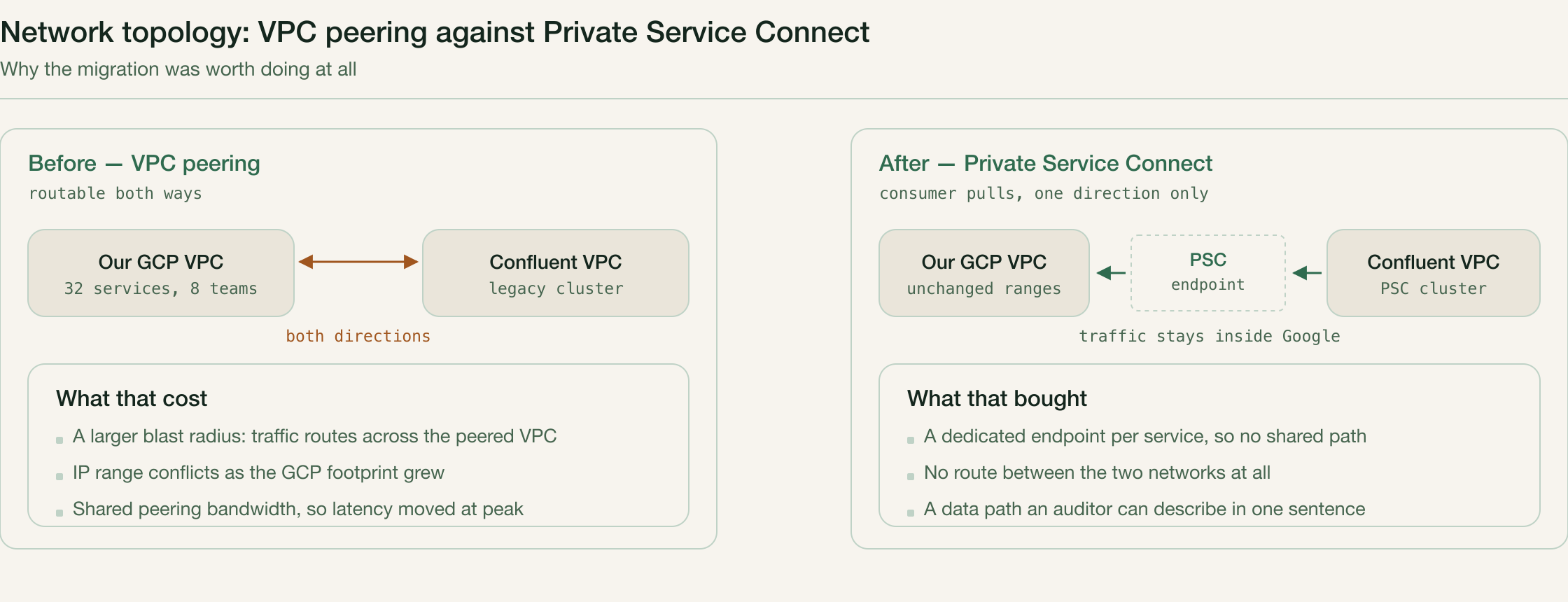
Private Service Connect (PSC) is a Google Cloud networking feature that allows private, encrypted connectivity between consumer and producer VPCs without traversing the public internet. Before PSC, our Confluent Cloud cluster used VPC peering, which introduced several pain points:
- Network traffic between services was routable across peered VPCs, creating a larger blast radius for security incidents
- IP address range conflicts as our GCP footprint expanded
- Inconsistent latency during peak hours due to shared peering bandwidth
- Compliance concerns around data traversal paths
PSC solved all of these: traffic stays entirely within Google's network, each service gets a dedicated private endpoint, and the connection model is strictly one-directional (consumer pulls from producer).
Migration architecture: the dual-cluster strategy
The core principle of zero-downtime Kafka migration is simple: run two clusters in parallel and migrate consumer groups incrementally. We called this our Blue (legacy) / Green (PSC) strategy.
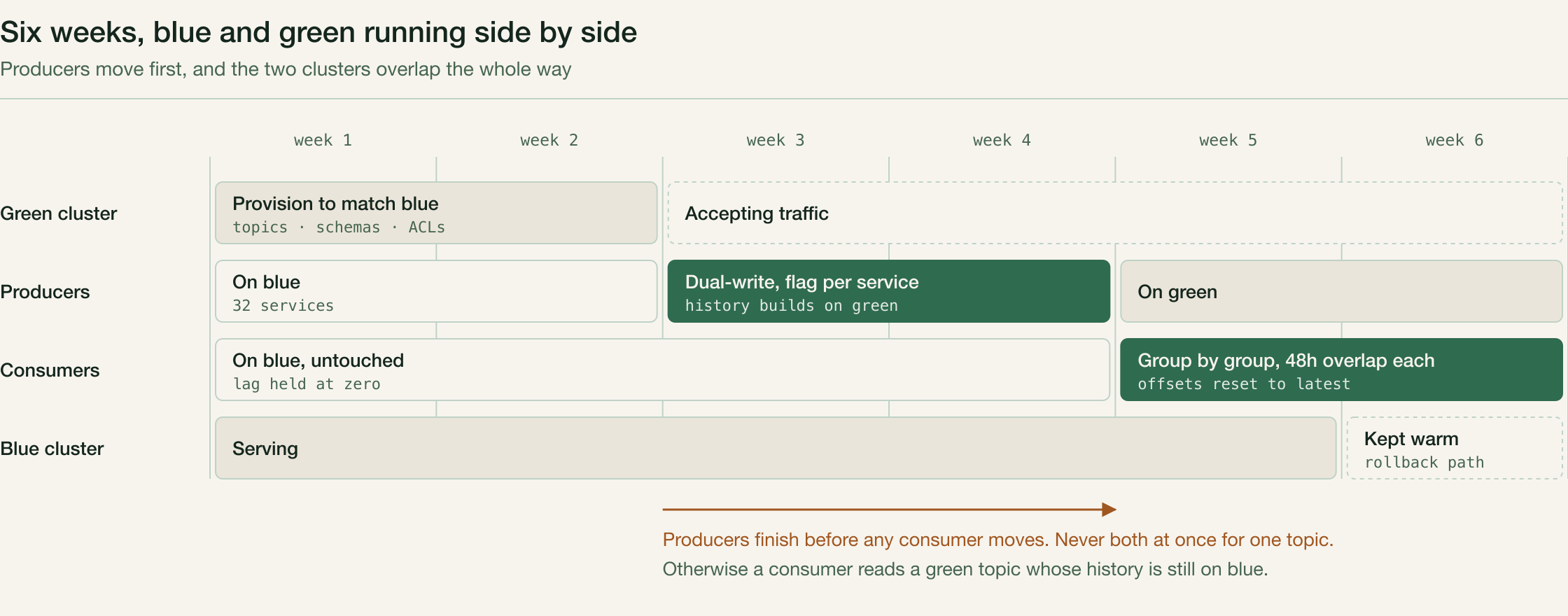
Phase 1: green cluster provisioning (week 1–2)
We provisioned the new PSC-enabled Confluent cluster in parallel with the existing peering-based cluster:
- Created identical topic configurations (partition counts, replication factors, retention policies)
- Set up Schema Registry replication to keep schemas in sync
- Configured identical ACLs and service accounts
- Established monitoring dashboards for both clusters in New Relic
- Validated network connectivity from every consumer service pod
# Example: Verify PSC endpoint connectivity from consumer pod
kubectl exec -it <consumer-pod> -- nc -zv <psc-endpoint> 9092
# Expected: Connection to <psc-endpoint> 9092 port succeeded
Phase 2: producer migration (week 3–4)
We migrated producers first, before any consumers. This allowed the green cluster to accumulate message history before consumers switched over:
- Identify producer services, We catalogued every application writing to Kafka (32 services across 8 teams)
- Feature-flag the broker URL, Each producer used an environment variable for the bootstrap server address. We added PSC endpoint as a feature-flagged override
- Shadow publishing, For critical topics (loan events, customer updates), we temporarily dual-published to both clusters using a custom wrapper that wrote to both brokers with identical keys
- Validate with lag monitoring, Confirmed consumer lag remained at zero on blue cluster before declaring producer migration complete
// Producer dual-write wrapper (simplified)
public void send(ProducerRecord<String, Object> record) {
    blueProducer.send(record);  // Legacy cluster
    if (pscFeatureEnabled) {
        greenProducer.send(record);  // PSC cluster
    }
}
Phase 3: consumer group migration (week 5–6)
This was the most delicate phase. We migrated consumer groups team-by-team, with a 48-hour overlap window for each:
- Reset consumer group offsets on green cluster to match current position on blue:
kafka-consumer-groups --reset-offsets --to-latest - Deploy consumer to green with
bootstrap.serverspointing to PSC endpoint - Monitor for 48 hours: consumer lag, error rates, processing latency
- Decommission blue consumer only after validation passes
Critical lesson: Never migrate producers and consumers for the same topic simultaneously. Always finish producer migration first, let offset history build on green, then migrate consumers. This gives you a replay buffer if anything goes wrong.
Handling the hard cases
Exactly-once semantics (EOS) producers
Several of our critical producers used Kafka transactions for exactly-once semantics. These required special handling because transaction IDs are cluster-scoped:
- Generate new unique
transactional.idvalues for green cluster (avoid collision with blue) - Disable dual-write for EOS producers, the transactional guarantees can't span clusters
- Use a hard cutover for EOS producers during a low-traffic window (Sunday 2–4 AM)
- Maintain blue cluster availability for 72 hours post-cutover as rollback option
Schema evolution during migration
Rather than replicating the registered schemas manually, we used Confluent's Schema Registry migration tooling:
# Export schemas from blue registry
confluent schema-registry cluster export --config blue-config.properties > schemas.json

# Import to green registry
confluent schema-registry cluster import --config green-config.properties --file schemas.json
Consumer groups with long retention windows
Some consumer groups (analytics, audit) had retention requirements of 7–14 days and needed to replay historical events. We handled this by:
- Keeping the blue cluster running for 14 additional days after consumer migration
- Setting offsets on green to the equivalent position via timestamp reset
- Running a one-time historical replay job from blue to green for gaps during the dual-write window
Monitoring and rollback strategy
We defined clear success/rollback criteria upfront and automated the rollback trigger:
Success criteria (per consumer group):
- Consumer lag < 100 messages for 4 consecutive hours
- Error rate < 0.01% for 48 hours
- P99 message processing latency within 10% of baseline
- No dead letter queue accumulation
Automated rollback trigger:
# New Relic alert condition: rollback trigger
SELECT count(*) FROM KafkaConsumerMetrics
WHERE consumer_lag > 10000
AND cluster = 'green-psc'
SINCE 15 minutes ago
Results
The migration completed 2 months ahead of schedule with:
- Zero downtime, not a single dropped message or consumer interruption
- No public internet traversal, PSC's dedicated private endpoints removed the peering path entirely
- Full schema compatibility, every registered schema migrated without a version conflict
- Every producer and consumer migrated without incident, on each team's own release cadence
Key lessons
- Always migrate producers before consumers. This gives consumers a buffer of historical events on the new cluster
- Feature-flag everything, broker URLs, schema registry URLs, consumer group IDs should all be configuration-driven
- Define rollback criteria before you start, not during the migration when you're under pressure
- Shadow-publish for critical topics. The cost of dual-writing is worth the safety net
- Automate the offset reset, manual offset management at scale is error-prone
- Communicate early and often, all 8 teams knew the migration calendar 6 weeks in advance
Zero-downtime migrations aren't magic. They're the result of careful planning, incremental execution, and a clear rollback strategy at every step. The techniques described here apply equally to Kafka version upgrades, cloud-to-cloud migrations, or any major streaming infrastructure change.
References
- Google Cloud, Private Service Connect Overview, cloud.google.com
- Confluent, Schema Registry Cluster Migration, docs.confluent.io
- Apache Kafka, Exactly-Once Semantics, kafka.apache.org/documentation
- Confluent, Consumer Group Offset Management, docs.confluent.io
Frequently asked questions
What happens if a rollback is triggered mid-migration?
Because producers dual-write during the migration window and the blue cluster stays live until validation passes, a rollback is just a feature-flag flip: point consumers back to the blue bootstrap servers and disable the PSC override. Nothing needs to be replayed or reconstructed, because blue never stopped receiving traffic. This is the entire reason the dual-cluster strategy costs more upfront than a hard cutover, the rollback path has to be this cheap or the plan doesn't hold up under pressure.
How long should the blue cluster stay alive after cutover?
We kept it running for 72 hours after standard consumer cutovers and 14 days for consumer groups with longer retention or audit requirements. The right window is whatever your longest downstream replay requirement is, not a fixed number. If an analytics job only reprocesses the last 24 hours, 72 hours of overlap is generous. If a compliance job replays 14 days on demand, the blue cluster needs to survive that long.
Does this approach work for a version upgrade instead of a cloud migration?
Yes. The dual-cluster, producers-before-consumers sequencing is agnostic to why you're standing up a new cluster, whether that's a new networking model like PSC, a major version upgrade, or a move between cloud providers entirely. The mechanics (shadow publishing, offset alignment, rollback triggers) are the same regardless of what's different about the green cluster.
What is the biggest risk in the producer migration phase specifically?
Silent divergence between blue and green during dual-write. If the wrapper that writes to both clusters has a bug, or if one cluster falls behind under load, you can end up with green looking healthy on lag metrics while actually missing messages. We caught this by comparing message counts per topic per hour across both clusters, not just consumer lag, lag alone doesn't tell you if the two clusters agree on what happened.